Futures trading is less well known than trading shares or forex, but it has some real advantages for a new trader. You trade on regulated exchanges, every trader sees the same price, and you can start with a much smaller account than a share day trader needs.
It also carries real risk. Futures are leveraged, so losses can build quickly if you don’t manage them. That’s why this guide puts as much weight on controlling risk as it does on placing trades.
Below you’ll learn what futures are, how a futures trade works, which markets suit beginners, a handful of beginner strategies, and the steps to place your first trade.
How to trade futures: the short answer
- Learn how futures work: contracts, margin, tick values and expiry dates.
- Choose one market: most beginners start with the Micro E-mini S&P 500.
- Set up your platform and data: a computer, a reliable connection and a futures trading platform.
- Open a futures trading account with a broker that routes your orders to the exchange.
- Write a trading plan: entry rules, exit rules and how much you’ll risk per trade.
- Practise on a simulator until you can followed your plan consistently.
- Place and manage your first live trade, with a stop loss set before you enter.
What is futures trading?
Futures trading is buying and selling standardised contracts that agree to exchange an asset at a set price on a future date. The contracts trade on regulated exchanges such as the CME Group, and their value comes from an underlying market.
Common futures contracts are based on:
- Stock indices, such as the S&P 500, Nasdaq 100 or ASX 200
- Commodities, such as crude oil, gold and wheat
- Currencies, such as the euro or Japanese yen
- Interest rates, such as US Treasury bonds
Most futures traders never take delivery of anything. They aim to profit from the price moving between when they open and close the contract, and they close the position well before expiry. You can buy a contract if you expect the price to rise (going long) or sell one if you expect it to fall (going short).
Because the contracts are standardised and cleared centrally, pricing is transparent and counterparty risk is lower than in many other products. Traders use futures to speculate on price, or to hedge positions they already hold.
How a futures trade works: an example
To understand how trading a futures contract works in practice, take crude oil.
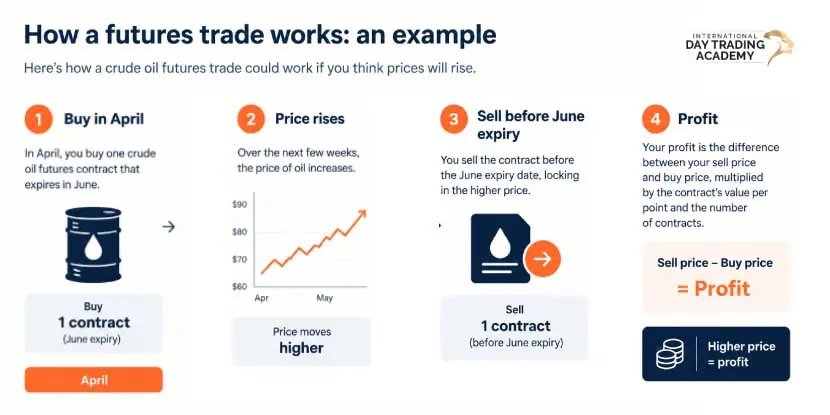
Say it’s April and you think oil prices will rise over the next few weeks. You buy one crude oil futures contract that expires in June. If the price rises, the contract is worth more and you can sell it for a profit before June. If the price falls, you can sell it to limit your loss.
If you expected oil to fall instead, you could sell a contract first and buy it back later at a lower price, keeping the difference.
Three things to keep in mind:
- You can close early. Contracts have set expiry months, but you can exit at any time the market is open.
- Profit and loss follow price movement. Your result is the difference between your entry and exit price, multiplied by the contract’s value per point and the number of contracts.
- Expiry dates vary. Check the expiry of the contract you’re trading before you place a trade.
For the full mechanics, including contract specifications, tick sizes and the history of futures, see our guide to what a futures contract is.
Why trade futures?
Futures have several features that suit day traders, and particularly traders starting with a modest account.
Fair and transparent pricing
Futures trade on centralised exchanges, so every trader sees the same price. With an over-the-counter (OTC) product such as a CFD, your broker sets the price you trade at, and that price can differ from the underlying market. With futures, your orders go to the exchange and there’s one price for traders big and small. Our comparison of CFDs and futures explains the difference in more detail.
Leverage
You don’t pay the full value of a contract. You put up an initial margin, which is a fraction of the contract’s value. That gives you more buying power, but it works both ways: losses are magnified just as much as gains. Leverage is a tool to use with a plan and strict risk management, not a reason to trade bigger.
Smaller account size
Many stock traders with small accounts run into the US pattern day trader rule, which limits day trading in accounts under US$25,000. That rule doesn’t apply to futures. You need enough to cover margin and a buffer for losses, and Micro E-mini contracts have much lower margin than the full-size versions.
Liquidity
Major futures markets such as the E-mini S&P 500 trade enormous volume every day. High liquidity means your orders can usually be filled quickly and close to the price you want. Trading products like Options, where some contracts trade thinly, can leave you waiting for a fill while the price moves away.
Long or short with equal ease
You can sell a futures contract as easily as you buy one. That means there can be opportunities in falling markets as well as rising ones, with no need to borrow shares first.
Choice of markets and hours
There are more than 70 futures markets, covering indices, energy, metals, currencies and interest rates. Many trade close to 24 hours a day on weekdays, so traders in Australia can trade US markets in the evening. If you’re weighing futures against currencies, our comparison of futures and forex covers the trade-offs.
Hedging
Futures aren’t only for speculators. If you hold a share portfolio and are worried about a fall, a short position on an index future could help offset losses while you keep your shares.
| Product | Liquidity | Transparent pricing | Short selling |
|---|---|---|---|
| Mid and large cap shares | Yes | Yes | Limited |
| Penny stocks | No | Yes | Limited |
| Forex (OTC) | Yes | No | Yes |
| Options | Varies | Yes | Yes |
| Futures | Yes | Yes | Yes |
Is futures trading good for beginners?
It can be, with the right preparation. Futures aren’t a product to jump into without training, because leverage means you can lose more quickly than in a share account, and in some cases more than you deposited.
What makes futures workable for a beginner is that most of that risk is controllable. You decide how much you risk on each trade, where your stop loss sits and when you stop trading for the day. Micro contracts let you trade at a small size, and simulation accounts let you practise with live prices and no money at risk.
The beginners who tend to do well treat it as a skill to learn in stages: understand the product, practise a defined strategy on a simulator, then trade live at the smallest size. Learning with an experienced futures educator can shorten that process and help you avoid the most common mistakes.
How to start futures trading: step by step
Here’s how to go from zero to your first live trade.
Step 1: Learn the basics
Before you trade, make sure you understand:
- Contract specifications: what the contract tracks, its tick size and how much each tick is worth
- Margin: how much you need to open and hold a position (more on this below)
- Leverage: how a small price move affects your account
- Trading hours and expiry: when your market is open and when each contract expires
Step 2: Choose one market
There are dozens of futures markets to choose from, but beginners do best focusing on one. Pick a liquid market whose hours suit you and whose moves suit your account size. The Micro E-mini S&P 500 is the most common starting point (see the best futures for beginners below). Some markets, such as the Germany 40 or crude oil, move more sharply and may suit you once you have experience.
Step 3: Set up your platform and data
You’ll need four things:
- A computer: a laptop or desktop trading computer that runs your software without lagging. It doesn’t need to be top of the range. Many traders use two screens: one for the timeframe they trade and one for a larger timeframe that gives market context.
- A reliable internet connection: markets can move quickly, and a dropout can leave you stuck in a trade. A wired broadband connection is best.
- A trading platform: the software you chart and trade from. Our preferred trading platform is NinjaTrader, which we and our members use. You’ll also want charting tools and a few day trading indicators that fit your strategy.
- Live market data: a data feed from the exchange so your platform can build charts and show real-time prices.
Platforms and data feeds have costs that add up, so research them before you commit. Many traders start with a basic setup and upgrade as their trading grows.
Step 4: Open a futures trading account
You need an account with a futures broker or clearing firm that sends your orders to the exchange. This is different from a CFD or OTC broker, which can set its own prices and take the other side of your trades. With a futures broker, you trade at the exchange price like everyone else.
Choose a broker that specialises in futures and offers the margin, platform and support you need. For Australian brokers, regulation and account set-up, see our guide on how to trade futures in Australia.
Step 5: Write a trading plan
A trading plan sets out exactly when you’ll enter, where you’ll exit if you’re wrong, where you’ll take profit, and how much you’ll risk. Most traders cap their risk at 1 to 2% of their account per trade. Your plan should also cover which hours you trade and when you’ll stop for the day.
This is where you control the part of the risk that’s within your hands. If your winning trades are larger than your losing ones, you don’t need to be right most of the time.
Step 6: Practise on a simulator
Most futures platforms, NinjaTrader included, offer a simulation account with live prices. Use it to test your trading strategies and to practise following your plan without real money at risk. Keep a trading journal from your first simulated trade. We call this approach “go slow to go fast”: don’t trade your own money until you’ve shown yourself you can follow your plan consistently.
Step 7: Place and manage your first trade
When you’re ready to trade live, keep it small. On your platform:
- Select the market and contract month you want to trade.
- Decide on direction: buy (go long) if your analysis points up, sell (go short) if it points down.
- Set your position size to match the risk in your plan. For most beginners that’s one micro contract.
- Set your stop loss and profit target before or as you enter. A stop loss closes your position automatically if the market moves against you.
- Monitor the trade. Watch price against your plan and use platform alerts for key levels. If the trade moves your way, you may move your stop to lock in some gain. If it doesn’t, let the stop do its job.
- Close the position with an opposite order (sell if you bought, buy if you sold), or let your stop or target close it. You don’t have to hold until expiry.
After each trade, record it in your journal and review whether you followed your plan.
Best futures to trade for beginners
Not every futures contract suits a beginner. These are the markets new traders most often start with, and why.
| Contract (symbol) | Why beginners use it | Things to know |
|---|---|---|
| Micro E-mini S&P 500 (MES) | One tenth the size of the E-mini, with low margin and very high liquidity | The most common first market |
| E-mini S&P 500 (ES) | Deep liquidity and a huge amount of market analysis to learn from | Larger contract, so more capital at risk per tick |
| Micro E-mini Nasdaq 100 (MNQ) | Small size on a popular index | Moves faster than the S&P 500 |
| Gold (GC, or Micro Gold MGC) | Widely followed, often reacts to big-picture economic news | Can move sharply around news |
| Euro FX (6E) | A forex trading alternative on a regulated exchange | Trades on currency news |
| US Treasury futures (ZN, ZB) | Lower volatility than index futures | Suits slower, range-based approaches |
| Crude oil (CL) | Popular for its volume and movement | Volatile; not for absolute beginners |
E-mini and Micro E-mini S&P 500 futures
The E-mini S&P 500 is one of the most traded futures contracts in the world. It tracks the S&P 500 index of large US companies. The Micro E-mini is the same market at one tenth of the size, so each point of movement has a tenth of the dollar value.
That’s why it’s our usual recommendation for a first market: you trade a deeply liquid, closely watched index while keeping the dollar risk per trade small. As your skill and account grow, you can move to the E-mini without having to learn a new market.
Futures trading strategies for beginners
You don’t need a complicated strategy. You need one with clear rules that you can follow every time. These five are common starting points.
1. Trend following
Trade in the direction the market is already moving. Trend trading often uses moving averages (such as a 20 and 50 period EMA), trend lines or momentum indicators like RSI or MACD to identify direction.
- Pros: simpler to follow than strategies that try to predict turns, and it can catch large moves
- Cons: entries can come late, and choppy sideways markets produce false signals
2. Breakout trading
Breakout trading means entering when price breaks through a clear support or resistance level, on the basis that the move may continue.
- Identify key levels from previous highs and lows or a consolidation range
- Wait for confirmation, such as a candle closing beyond the level or a rise in volume
- Enter as price breaks out, with a stop just inside the range
3. Mean reversion
Mean-reversion strategies assume price tends to move back towards its average after stretching away from it. Traders use tools such as Bollinger Bands, RSI divergence and moving averages. They tend to suit calmer markets, such as Treasury futures, or periods when a market is trading sideways.
4. News and event-based trading
Futures react strongly to scheduled economic releases, such as FOMC interest rate decisions, US non-farm payrolls, inflation data (CPI and PPI) and crude oil inventories. Know the economic calendar for your market. Many beginners do best by avoiding high-impact news altogether until they have experience.
5. Scalping
Scalping means making many short trades during the day to capture small moves. It works best on liquid contracts such as MES, ES or NQ. It demands precision, discipline, low transaction costs and strict risk management, so practise it on a simulator before going live.
Whichever you choose, test it on historical data and in simulation before you put real money behind it.
How much money do you need to trade futures?
You can open an account with some futures brokers with as little as US$500 to US$1,000 and trade micro contracts. We recommend starting with at least US$3,000. Standard-size contracts may need US$5,000 or more. Whatever the figure, only trade money you can afford to lose.
How margin works
You need a margin account to trade futures. Margin is the deposit you put up to open and hold a position. It acts as collateral rather than the full price of the contract.
- Initial margin is the minimum set by the exchange, such as CME Group or ICE, to open a position. Your broker may ask for more.
- Day trading margin is often lower than the overnight figure and is set by your broker for positions closed the same day.
- Margin varies by contract. Micro E-minis need far less than full-size contracts.
If your account falls below the required margin, your broker may issue a margin call or close your position.
Can you trade futures with a small account?
Technically, some brokers will let you open an account with a few hundred dollars, or even $100. In practice, a very small account has serious limits:
- Margin: even micro contracts often need more than $100 in margin per contract
- Volatility: a normal move against you could wipe out the balance before you can react
- No room for a proper stop: you may be forced to use stops so tight that ordinary price noise takes you out
A few hundred to a few thousand dollars gives you room to set sensible stops and manage trades properly. Micro E-minis were designed with smaller accounts in mind and are the most practical entry point.
Risks and downsides of trading futures
Every form of trading carries two outcomes: the chance to make money and the chance to lose it. Futures have some specific risks to understand before you start.
- Leverage cuts both ways. A small move against you can produce a large loss relative to your account. In some cases, losses can exceed your deposit.
- Markets can gap. Prices can jump past your stop on major news or after a market close, so your loss may be larger than planned.
- Expiry dates need tracking. If you hold positions for days or weeks, you’ll need to roll them to the next contract before expiry.
- Costs add up. Commissions, exchange fees, platform fees and data fees all come out of your results, especially if you trade often.
- Emotions are a risk too. Fear and greed lead to moved stops, revenge trades and overtrading.
The good news is that much of this is manageable. Position sizing, stop losses and a written plan put limits on the part of the risk you control. Our guide to trading risk management goes into the details.
Tips for futures trading success
Most beginners who struggle are missing the same few things. These habits help close the gap.
- Have a proven strategy with clear rules. Trading without one is probably the biggest reason new traders fail. Every trade should have a defined entry, stop and target.
- Always use a stop loss. It protects you from large losses so you can trade another day.
- Size your positions. Never risk more than 1 to 2% of your account on one trade.
- Aim for winners larger than losers. A favourable risk reward ratio reduces how often you need to be right.
- Focus on one market. Learn how it moves before adding another.
- Keep a trading journal. Record your entry, exit, reasoning and how you felt, and review it weekly.
- Back-test before you trade live. Use historical data and a simulator to test your edge.
- Know the calendar. Check scheduled economic news for your market each day.
- Avoid holding overnight while you learn. Overnight positions carry higher margin and gap risk.
- Work on your mindset. Trading psychology matters as much as your strategy. Notice when fear or greed is driving decisions.
- Be patient. Overtrading is a common way to give back gains. Good setups are worth waiting for.
The best way to learn futures trading
You can teach yourself, but self-taught learning tends to be unstructured: a patchwork of techniques from different sources with nobody to check your work. A structured path with support usually gets you to consistent, rule-based trading sooner.
Start with free resources
If you’re on a tight budget, start with what costs nothing. IDTA offers free day trading books, free day trading classes and day trading workshops to help you build a foundation before you spend anything.
Learn from an experienced futures educator
Investing time and effort in your education is the best way to learn trading. Look for an educator who teaches a defined strategy, provides ongoing support and has a long record of teaching futures to beginners. Choose a program you’re confident you can follow. If you’re ready for structured training, our Futures trading course for beginners is built for people who’ve never traded. You can compare all our options on the trading courses page.
Learn in a live trading room
A live trading room is an online session where trades are called live in the market, in real time. It’s one of the most useful ways to see a strategy applied, with all its winners and losers.
We’d go so far as to say that if an educator won’t call trades live, it’s fair to ask why. Look for one that runs a live room and lets you see it before you commit. See how ours works on our Live Trading Room page.
Go slow to go fast
Whatever path you take, practise in a simulation account before you risk real money, and only trade live once you’ve shown yourself you can follow your plan. It’s the approach we teach every member.
Futures trading FAQs